


By Agencies and published by CNA
 BEIRUT – United States President Donald Trump claimed the right to join Iran in deciding its next leader as the war escalated on Thursday (Mar. 5), with US and Israeli jets hitting areas across the country and Gulf cities coming under renewed bombardment.
“We want to be involved in the process of choosing the person who is going to lead Iran into the future,” he said in a phone interview with Reuters.
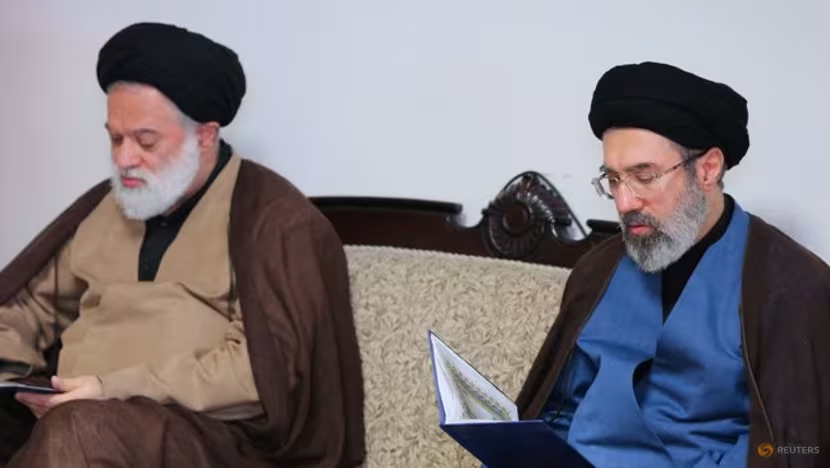
He rejected the possibility of Supreme Leader Ayatollah Ali Khamenei’s son, Mojtaba Khamenei, replacing his slain father, dismissing the younger man as a “lightweight” in an interview with Axios.
Trump also encouraged Iranian Kurdish forces to go on the offensive.
“I’d be all for it,” said Trump, whose administration has had contact with Iranian Kurdish groups since the US-Israeli strikes began.
He would not say whether the US would provide air cover for any Kurdish offensive.
The attack is a major political gamble for the Republican president, with opinion polls showing little public support and Americans concerned about the rise in gasoline prices caused by disruption to energy supplies. Trump dismissed that concern.
Tehran, Beirut strikes
On the war’s sixth day, Iran launched a series of attacks on Israel, the United Arab Emirates and Qatar. Fire crews in Bahrain extinguished a blaze at a refinery following a missile strike.
Two drone attacks targeted an Iranian opposition camp in Iraqi Kurdistan, as well as an oil field operated by an American firm, security sources said.
The Israeli military warned residents to evacuate areas, including eastern Tehran, while Iranian media reported blasts were heard in various parts of the capital.
An air attack killed 17 people in a guest house on a road northwest of the capital, Iranian state television said.
“Today is worse than yesterday. They are striking northern Tehran. We have nowhere to go. It is like a war zone. Help us,” said Mohammadreza, 36, by phone from Tehran, with a shaky voice as explosions rang out from what Israel described as its latest wave of strikes on Iranian government targets.
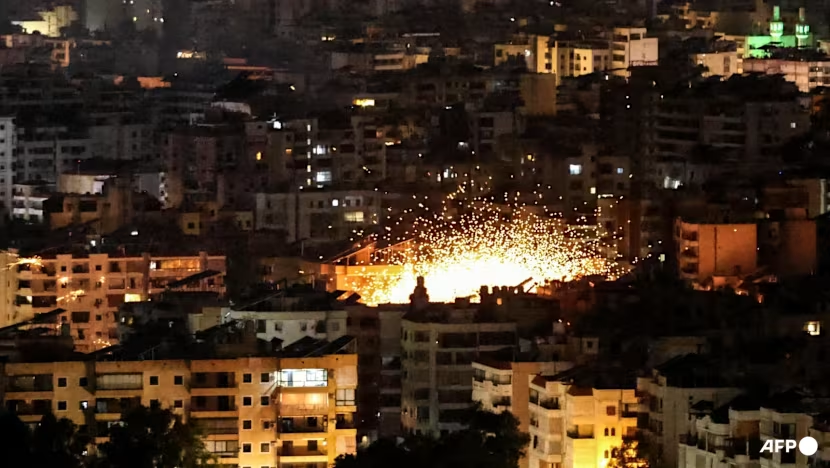
Strikes also hit Lebanon, which was dragged into the conflict on Monday after Hezbollah attacked Israel to avenge Khamenei.
In a message to residents of Beirut’s southern Dahiyeh suburbs, an Israeli military spokesman said: “Save your lives and evacuate your residences immediately.”
Israel’s military later announced it had “begun striking Hezbollah infrastructure” in Dahiyeh.
The warning sent people fleeing from the area, with massive traffic jams on the outskirts of the suburbs, as people fired guns in the air, urging locals to leave as soon as possible.
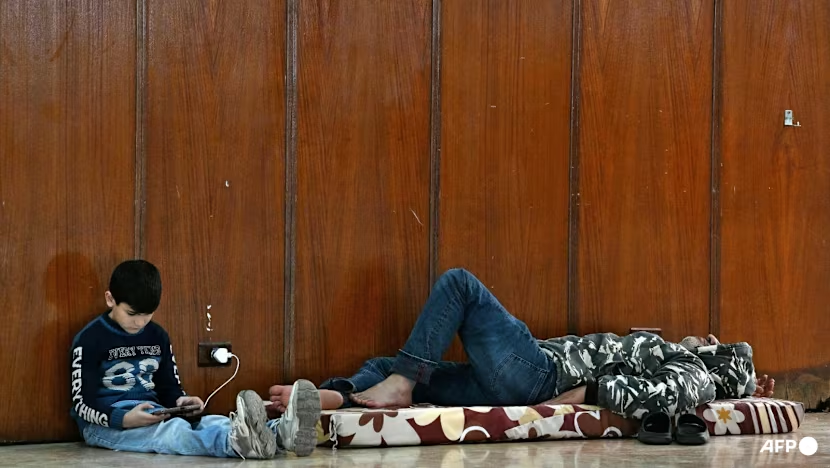
On a Beirut beach, hundreds of families, many of them scared and angry, milled around after fleeing in haste, having nowhere else to go.
“We fled from the suburbs, we were humiliated,” one man told AFP, declining to give his name.
“We’ll sleep on the road tonight and God alone knows what will happen to us.”
Lebanese authorities say at least 123 people have been killed, 683 wounded and at least 90,000 displaced since Monday.
Many munitions, Iran’s attacks dropped
US Defense Secretary Pete Hegseth and Admiral Brad Cooper, who leads US forces in the Middle East, said that the US has enough munitions to continue its bombardment indefinitely.
“Iran is hoping that we cannot sustain this, which is a really bad miscalculation,” Hegseth told reporters at Central Command headquarters in Florida.
“Our munitions are full up and our will is ironclad.”
Cooper said the US had now hit at least 30 Iranian ships, including a large drone carrier that he said was the size of a World War II aircraft carrier.
He added that B-2 bombers had in the past few hours dropped dozens of 2,000 penetrator bombs targeting deeply buried ballistic missile launchers, and that bombings were also targeting Iran’s missile production facilities.
Iran’s ballistic missile attacks had decreased by 90 percent since the first day of the war, while drone attacks had decreased by 83 percent in that time frame, he said.
Warning sirens blare in multiple nations
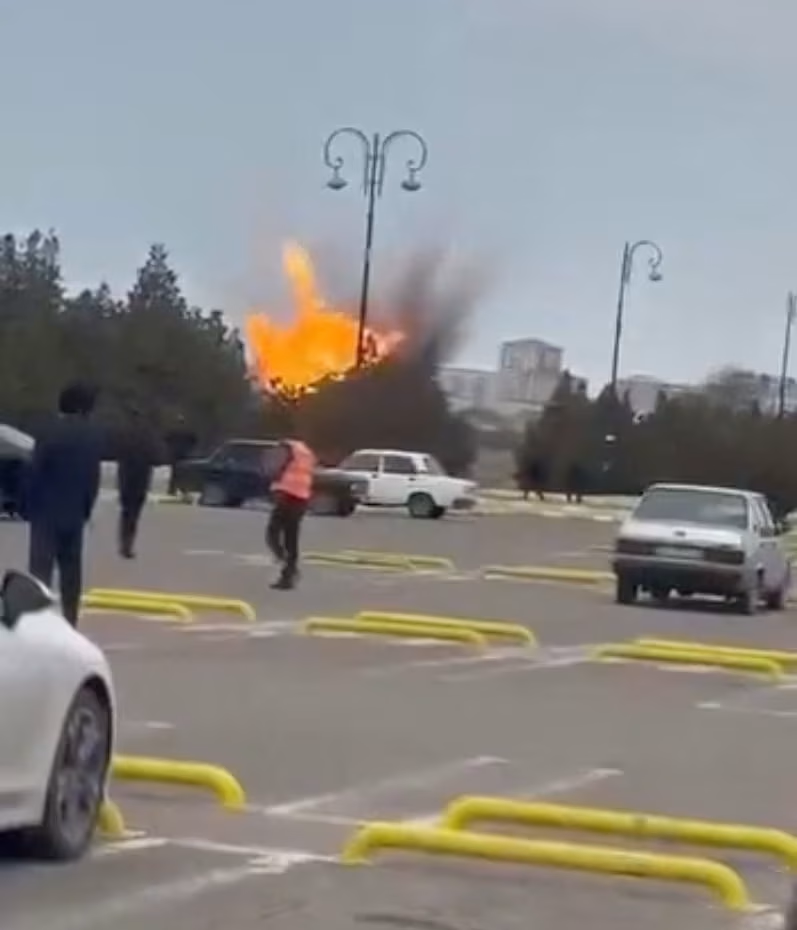
Azerbaijan on Thursday became the latest country drawn in, as it accused Iran of firing drones at its territory and ordered its southern airspace closed for 12 hours.
Iran, which has a significant Azeri minority, denied it had targeted its neighbour, but the episode underlined how rapidly the war has spread since the surprise US and Israeli airstrikes that killed Khamenei on Saturday.
Along with the gleaming cities of the Gulf, in easy range of Iranian drones and missiles, Cyprus and Turkey have both been targeted.
European nations have pledged to deploy ships to the eastern Mediterranean and hostilities have been seen as far afield as waters off Sri Lanka, where a US submarine sank an Iranian warship on Tuesday, killing 80 crew members.
In Iran, at least 1,230 people have been killed, according to the Iranian Red Crescent Society, including 175 schoolgirls and staff killed at a primary school in Minab in the country’s south on the first day of the war.
Netanyahu says ‘much work still lies ahead”
Shares on Wall Street fell on Thursday, weighed by surging oil prices, as the economic impact of the campaign intensified, with countries around the world cut off from a fifth of global supplies of oil and liquefied natural gas.
Air transport is also still facing chaos and global logistics have been increasingly snarled.
On Thursday, Iran’s Revolutionary Guards said they had hit a US tanker in the northern part of the Gulf and the vessel was on fire, the latest of numerous reports of such attacks.
Visiting an air force base in the south of the country, Israeli Prime Minister Benjamin Netanyahu said Israel’s achievements so far in Iran had been “great” but that “much work still lies ahead”.
Iran’s foreign minister said Washington would “bitterly regret” the precedent it had set by sinking a ship in international waters without warning.
A commander of the Revolutionary Guards, General Kioumars Heydari, told state TV: “We have decided to fight Americans wherever they are.”
The body of Supreme Leader Ayatollah Ali Khamenei, killed in the first hours of the US-Israeli air campaign in the first assassination of a country’s top ruler by an airstrike, was due to lie in state in a Tehran prayer hall from Wednesday evening to launch three days of mourning.
But the memorial, expected to draw many thousands of mourners to the streets, was abruptly postponed.
Two sources familiar with Israel’s battle plans said that Israel, having killed many Iranian leaders, was now planning to enter a second phase when it would target underground bunkers where Iran stores its missiles.
Gulf under fire
The conflict has not spared the rich Gulf monarchies, usually seen as a safe haven in a volatile region, as Iran has lashed out at cities and energy infrastructure.
Thirteen people, seven of them civilians, have been killed in countries around the Gulf since the war began, including an 11-year-old girl in Kuwait.
Qatar said on Thursday it was intercepting an incoming missile attack as loud blasts, described by AFP journalists as the most intense yet, reverberated across Doha, where thick black smoke billowed across the horizon.
Falling debris from an intercepted drone also injured six people in the Emirati capital Abu Dhabi, officials said.
In Bahrain, an Iranian missile strike sparked a blaze at the main state-owned oil refinery, which was later contained, the Gulf country’s communications centre said.
And some Western diplomats in the Saudi capital Riyadh, meanwhile, said they were told on Thursday to shelter in place, while a witness said the diplomatic quarter in the city had been closed off.
CAPTIONS:
Top – US President Donald Trump speaks during an event in the Indian Treaty Room of the Eisenhower Executive Office Building on the White House complex on Wednesday. Photo – Jacquelyn Martin/AP and published by CNN
Front Page – US President Donald Trump speaks during a Medal of Honour ceremony at the White House in Washington, DC, US, on Mar. 2, 2026. File photo: Reuters/Ken Cedeno and published by CNA
First insert – Mojtaba Khamenei (left) visits Hezbollah’s office in Tehran, Iran, on Oct. 1, 2024. Photo: Reuters/West Asia News Agency/Office of the Iranian Supreme Leader and published by CNA
Second insert – Fire blazes erupt from the site of an Israeli airstrike that targeted Beirut’s southern suburbs in Lebanon on Mar. 5, 2026. Photo: AFP/Ibrahim Amro and published by CNA
Third insert – People sit inside a school transformed into a shelter for displaced people in the town of Dekwaneh, north of Beirut, Lebanon, on Mar. 5, 2026. Photo: AFP/Joseph Eid and published by CNA
Fourth insert – A drone explodes at the airport of Nakhchivan, Azerbaijan, in this screengrab obtained from a social media video released on Mar. 5, 2026. Image: Social media via Reuters and published by CNA
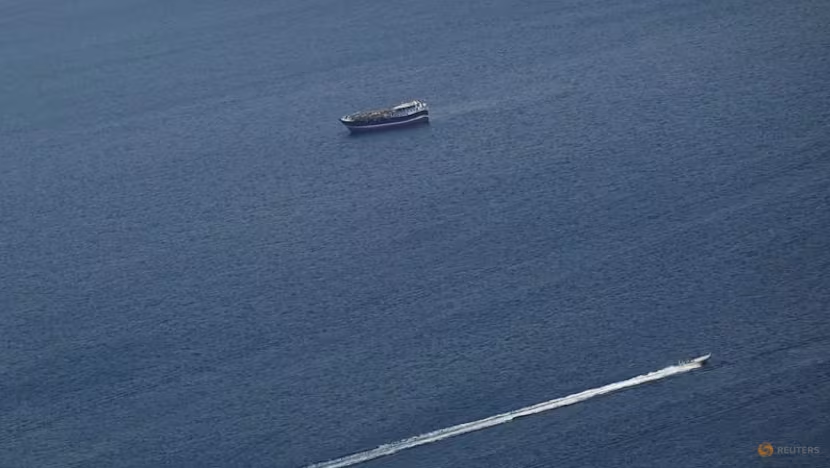
Fifth insert – Boats in the Strait of Hormuz amid the US-Israeli conflict with Iran, as seen from Musandam, Oman, on Mar. 2, 2026. Photo: REUTERS/Amr Alfiky and published by CNA
A video captured by crew members of a commercial ship shows Tomahawk missiles flying right past them en route to targets in Iran. Shared by Ryan Fournier on X.com:
https://x.com/i/status/2029248108408787183
Also read:
US hasn’t asked to use U-Tapao Airport: Minister
Lesson from Tehran: Unsecured surveillance cameras are a tool for opponents
Public urged to not hoard fuel with diesel price fixed for 15 days
War jitters lead to rush to fill up and stockpile fuel in Chiang Rai, Nakhon Sawan
As Mideast conflict widens, US says attacks on Iran will last weeks and intensify
Newin to have final say over Bhumjaithai ministerial seats
100 party-listed, designate-MPs initially verified
No old-timer politicians welcome in Bhumjaithai-led cabinet
No Klatham MPs to vote Anutin for PM unless brought into Bhumjaithai-led coalition
People’s to file duty-negligence, misconduct lawsuit against Election Commission
Bhumjaithai-led coalition finally opts to do without Klatham, Democrats


