


By AP and published by Yahoo!Finance
Frankfurt, Germany – Whatever domestic economic gain comes from US President Donald Trump’s new 25% tax on imported cars – and experts are sceptical – automakers around the world are bracing for a lot of pain.
In Japan, South Korea, Mexico, Canada and across Europe, the world’s largest automakers employ millions of people whose livelihoods depend on US car buyers, who currently spend more than $240 billion annually on imported cars and light trucks.
The Trump tariffs — aimed at boosting US jobs and tax revenues — will also affect imported auto parts, which were valued at $197 billion last year.
“The impact will be really huge and very disruptive,” said Sigrid de Vries, director general of the European Automobile Manufacturers’ Association. Vries and others critics say American car shoppers will also be worse off, as tariffs push prices higher.
Policymakers around the world said they were weighing their next moves — namely, whether to retaliate or not, and if so, how. But they also expressed hope that negotiations with Washington could avert an escalating trade war, and the economic damage and global supply chain disruptions that would come with it.
The impending hit comes on top of other tariffs planned globally on steel and aluminium, and at a time when competition from China, and the transition to electric vehicles, is already putting immense pressure on the world’s leading car makers.
The anticipated blow could be felt Thursday in the stock prices of many major automakers, including Toyota, Mercedes-Benz, Kia and BMW. US carmakers are less exposed to possible retaliation because they export only 2% of their production to the EU. Still, shares of Ford and General Motors fell because the US industry relies heavily on cross-border trade in auto parts, although Tesla is an exception and its stock price rose on Thursday.
Most foreign carmakers have plants in the US – Japanese carmakers have two dozen, for example – but that would not shield them if they use imported parts, unless those parts are exempted under a free-trade agreement with Mexico and Canada.
The auto tariffs will be felt sharply in Europe, for whom the US is the biggest export market for an industry that supports nearly 14 million jobs.
The EU’s top trade official, Maros Sefcovic, has travelled to Washington at least twice since Trump was reelected to try to engage the administration. But the Trump administration says its tariffs, which the White House says would raise $100 billion in revenue annually, are “permanent.”
“We’re ending the unfair trade practices that have been hollowing out our middle class,” said White House press secretary Karoline Leavitt. “The president is determined to rebuild our manufacturing base.”
The head of the United Auto Workers, Shawn Fain, thanked the White House “for stepping up to end the free trade disaster that has devastated working class communities for decades.”
The president on Monday cited plans by South Korean automaker Hyundai to build a $5.8 billion steel plant in Louisiana as evidence that tariffs would bring back manufacturing jobs.
Economists say the tariffs will only raise costs that will be passed on to consumers and lead to a cycle of retaliation that will reduce trade between countries.
“There’s a risk of retaliatory tariffs and then a tit-for-tat, and then we end up with significant barriers to trade and we all lose out,” said Professor David Bailey, professor of business economics at the University of Birmingham. “That’s the fundamental problem here, essentially that governments will start to retaliate against each other.”
Trump has already placed a 20% tax on all imports from China for its role in the production of fentanyl. He similarly placed 25% tariffs on Mexico and Canada, in part to pressure them to help reduce illegal immigration to the US. And he has imposed 25% tariffs on all steel and aluminium imports — and said he plans tariffs on computer chips, pharmaceutical drugs, lumber and copper.
Before the new auto tariffs were announced, the EU had been planning to re-impose suspended tariffs in mid-April on a range of US goods, including jeans, bourbon and motorcycles, as part of a previous dispute over trade in steel and aluminium. More tariffs could be imposed in response to the latest 25% increase in steel and aluminum tariffs
“We have our plans ready,” said EU foreign affairs representative Kaja Kallas. But she said there is still uncertainty about which tariffs Trump will follow through on, and which can be resolved through negotiations.
Japanese Prime Minister Shigeru Ishiba reiterated a request on Thursday that his country’s automakers be exempted from Trump’s tariffs. When asked about possible responses, he said “all options” are on the table, without giving specifics.
The union that represents auto workers in Canada lashed out at Trump’s decision, and called on their prime minister, Mark Carney, to retaliate if necessary.
“We have never seen an attack like this but we are ready,” said Lana Payne, the National President of Unifor. She said Carney should tell Trump that if US automakers are going to sell cars and trucks in Canada they are going to have to build in Canada.
Autos are Canada’s second largest export, and on Wednesday — before Trump made his announcement — Carney unveiled a $2 billion Canadian (US$1.4 billion) “strategic response fund” that will protect Canadian auto jobs affected by the tariffs.
For now, international auto companies are reluctant to make expensive operational changes, such as adjusting supply chains or relocating more production to the US, since it is still possible the tariffs will be withdrawn by Trump if they cause too much economic pain for Americans, according to analysts at the Sanford C. Bernstein research firm.
“Despite claims that the tariffs would last for Trump’s full term, we think it is unlikely that the new tariff regime will last, given the wide-spread damage they will do across industries and the inflationary impact on the US economy,” they wrote. They pointed out that the last tariff escalation between the US and China impacting autos only lasted from July to December 2018 during Trump’s first term in office.
The 25% tariffs — if kept in place over the long-term — could add as much as $12,000 per imported vehicle purchased in the US, Bernstein analysts estimate. Of course, carmakers will ultimately determine how much of the Trump tariffs to pass along to consumers, as opposed to taking a hit in their profit margins.
The blow will not fall evenly. The most exposed among European automakers are German and Italian carmakers since 24% of German and 30% of Italian non-EU exports go to the US. Japan and South Korea are also major exporters, while Canada and Mexico are deeply integrated into US carmakers supply chains.
Europe’s carmakers already face a shrunken domestic market and new competition from cheaper Chinese electric vehicles. Any trouble in the auto industry would weigh on the European economy that did not grow at all in the last quarter of 2024 and just 0.9% for the entire year.
“This would deliver a substantial blow to a sector that not only sustains millions of jobs but also contributes to a large proportion of the bloc’s GDP,” wrote analyst Clarissa Hahn at Oxford Economics.
Top countries sending cars, parts to US
Mexico, Japan and South Korea ranked as the top countries of origin for US-bound automobiles last year.
Top sources of auto and auto parts imported to United States, 2024
Autos
Mexico – $78.5B
Japan – $39.73B
South Korea – $36.64B
Canada – $31.16B
Germany – $24.78B
United Kingdom – $8.19B
Slovakia – $6.25B
Sweden – $3.86B
Italy – $3.33B
China – $2.55B
Auto parts
Mexico – $81.17B
Canada – $19.47B
China – $18.26B
Japan – $15.8B
South Korea – $12.67B
Germany – $10.11B
Thailand – $5.43B
Taiwan – $3.41B
Vietnam – $3.16B
India – $3.1B
Source: International Trade Administration
CAPTIONS:
Top: Opel cars are parked on the grounds of the Opel car factory in Ruesselsheim near Frankfurt, Germany, yesterday, March 27. 2025. Photo: AP/ Michael Pobst and published by Canadian Press
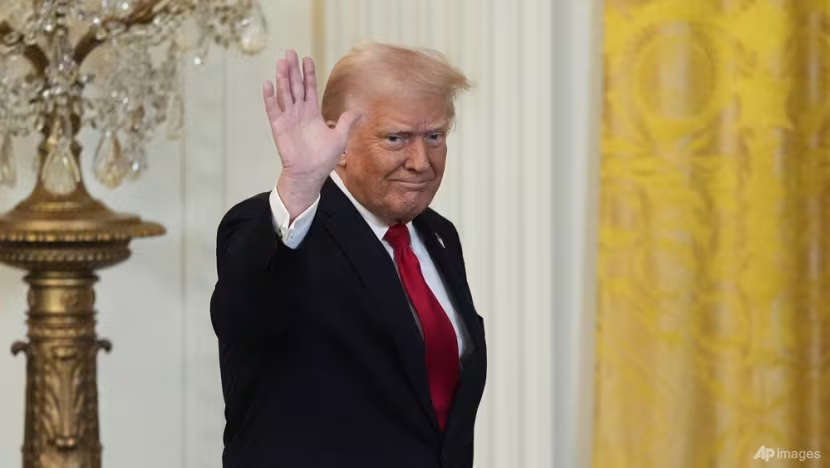
Insert: US President Donald Trump waves after speaking at a reception at the White House, on March 26, 2025. Photo: AP/Mark Schiefelbein and published by CNA
Front Page: Cars are seen at the Mercedes-Benz Vehicle Preparation Centre at the Port of Baltimore on March 27, 2025. Photo: AP/Stephanie Scarbrough and published by CNA
Also read: Trump places 25% tariff on imported autos
Entertainment complexes, casinos to draw 100 billion baht investment: Julapun
Pathum Thani residents cheer as monorail project moves forward
Graft-busters uncover ticket scam at Similan National Park
Paetongtarn smoothly survives censure motion
Paetongtarn dismisses Thaksin’s ‘deal with the Devil’

